
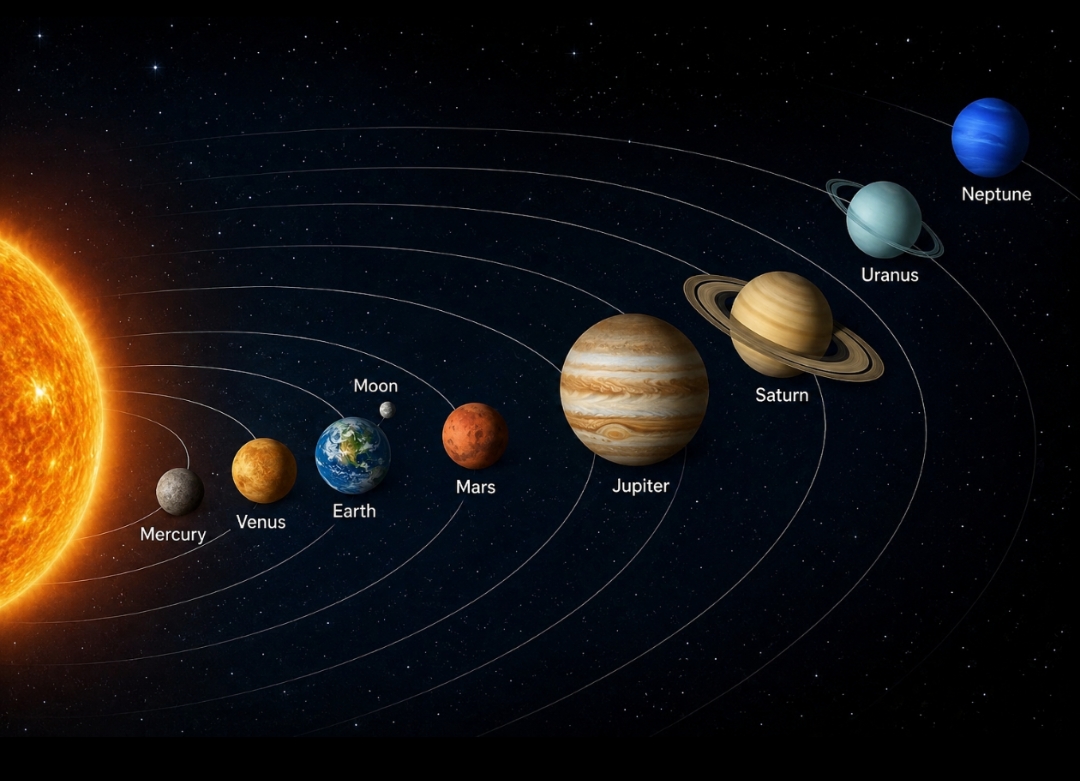
The Solar System
The Solar System is a group of planets, moons, asteroids, comets, and other objects that move around the Sun. The Sun is at the center of the Solar System and gives heat and light to all the planets. The Solar System was formed about 4.6 billion years ago.
The Sun
The Sun is a huge ball of hot gases. It is the main source of energy for life on Earth. The Sun contains most of the mass of the Solar System.
The Eight Planets
1. Mercury
Mercury is the smallest planet and the closest to the Sun. It has no atmosphere to protect it from heat or cold.
2. Venus
Venus is the hottest planet because of its thick atmosphere. It is often called Earth’s twin because of its similar size.
3. Earth
Earth is the only known planet where life exists. It has water, air, and suitable temperature for living things.
4. Mars
Mars is known as the Red Planet because of its reddish color. Scientists study Mars to learn if life ever existed there.
5. Jupiter
Jupiter is the biggest planet. It is a gas giant and has a very strong storm called the Great Red Spot.
6. Saturn
Saturn is famous for its beautiful rings made of ice and rock particles.
7. Uranus
Uranus rotates on its side. It is an icy planet with a pale blue color.
8. Neptune
Neptune is the farthest planet from the Sun. It is very cold and has strong winds.
Other Objects in the Solar System
Moons move around planets.
Asteroids are rocky objects mostly found in the asteroid belt.
Comets are made of ice and dust and develop tails near the Sun.
Meteors are small rocks that burn when entering Earth’s atmosphere.
Conclusion
The Solar System is a fascinating part of space. Scientists continue to explore it to understand more about planets, stars, and the universe.