
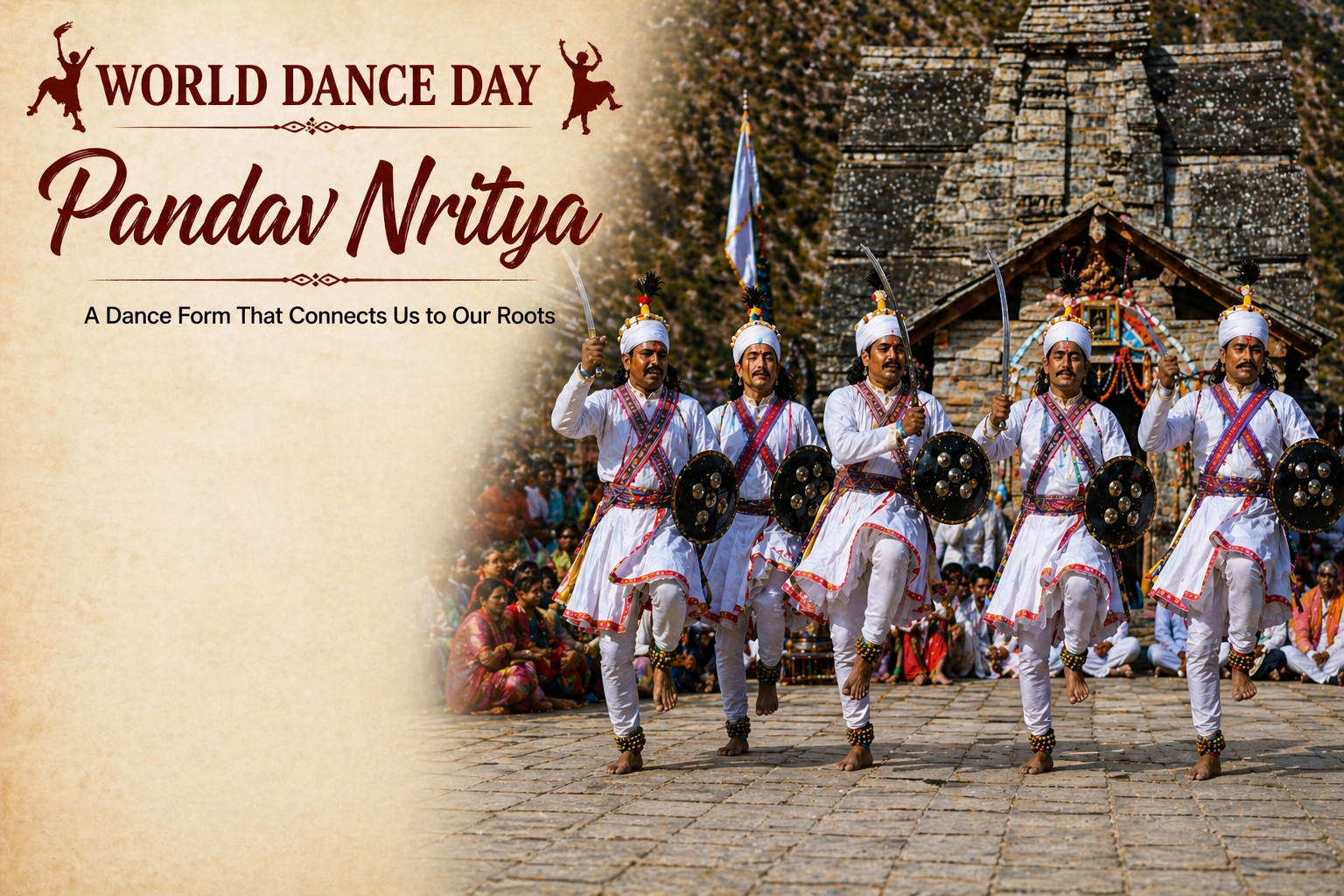
This World Dance Day, instead of exploring a famous international dance form, I would like to take you on a journey to discover a beautiful dance form from our own culture—something deeply rooted in our traditions.
I am going to talk about *Pandav Nritya*, a dance form that also connects me to my roots.
Pandav Nritya is a traditional folk dance that is much more than just entertainment. It is a **ritualistic dance-drama** that combines dance, music, storytelling, and spirituality.
This dance form is inspired by the Mahabharata and focuses on the lives of the five Pandava brothers. Through this performance, people bring these ancient stories to life and keep their traditions alive even today.
Pandav Nritya is usually performed during religious festivals and special occasions in villages. It takes place in open spaces where the entire community gathers, creating a strong sense of unity and belonging.
One of the most unique aspects of this dance is its **spiritual nature**. It is believed that during the performance, some dancers enter a trance-like state and feel a deep connection with the characters they portray. This makes the performance very powerful and emotional.
The dance is performed in groups, where each performer plays a specific role from the Mahabharata. Along with dance movements, there is singing and narration, which helps the audience understand the story clearly. Expressions and gestures play an important role in showing different emotions.
Music is also a key element of Pandav Nritya. Traditional instruments like the dhol and damau create rhythm and energy, guiding the dancers and enhancing the performance.
The costumes are usually simple and traditional, which adds to the authenticity of the dance and keeps the focus on the storytelling.
Pandav Nritya is not just a performance—it is a way of preserving culture, history, and beliefs, and passing them on to future generations.
Compared to dance forms like Kathak, which focus more on technique and stage performance, Pandav Nritya focuses more on **devotion, storytelling, and community participation**.
**To conclude**, Pandav Nritya reminds us that sometimes the most meaningful art forms are not the most popular ones, but the ones closest to our roots.
**Thank you.**