
In the sixth century before the birth of Christ,
Amidst this trembling dawn of spiritual revolution, two extraordinary figures walked the same dust: Siddhartha, the Buddha, and Vardhamana, the Mahavira. Both were born to the luxury of "silk and gold"—one a prince of the Shakyas, the other a prince of the Licchavi kingdom. Yet, both felt the shadow of death and the futility of possession. They walked away from their palaces to find that which is eternal. While history remains silent on whether their physical paths ever crossed, their philosophies represent a "meeting of consciousness" in the infinite sky of human awareness, offering a profound roadmap for the modern seeker.
The Moonlight and the Sun
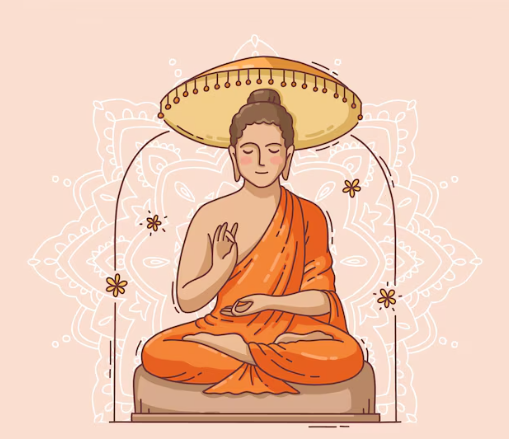
The methodologies for enlightenment proposed by these two masters represent two distinct notes in the same eternal music. Siddhartha, after years of breaking his body through extreme asceticism, realized that a broken instrument cannot play a divine melody. He emerged from beneath the Bodhi tree to teach the Middle Path—a way of balance, wakefulness, and "understanding" rather than struggle. His presence was gentle, his words falling like moonlight upon a fevered world, emphasizing that suffering ends when we cease to cling.
In stark contrast, Vardhamana took the Razor’s Edge. At the age of thirty, he renounced everything—even his clothing—and walked naked into the world. His was a path of fire and unyielding purity. He stood unmoving in the blazing sun, fasting for months, even letting snakes crawl across his feet as he conquered hunger, pride, and pain. If the Buddha was the gentle moon, Mahavira was the sun at noon, a "great hero" who demonstrated that the spirit could be forged in the furnace of absolute discipline.
"One taught the art of balance, the other the art of purity. One said, 'Walk in the middle.' The other said, 'Walk to the end.'"
The Mirror and the Dust
An imagined dialogue between these two masters reveals the exquisite architecture of the mind. For the Buddha, the primary tool of liberation was clarity. He suggested that when the mind sees the root of craving, desire dissolves naturally, like mist before the morning sun. He warned that "too much effort creates tension," and in a tense mind, the flower of awareness can never bloom.
Mahavira, however, looked at the "dust" of the senses. He argued that attachments and ancient karmas so obscure the mirror of the mind that it cannot reflect anything until it is scrubbed clean. To him, discipline was the first doorway. Without the fire of renunciation, the act of "letting go" risks becoming a mask for spiritual laziness.
"To understand, the senses must first be purified. How can the mirror reflect truth when it is covered in dust? Discipline is the first doorway."
The Fragrance of Non-Violence
Central to Mahavira’s message was the radical, uncompromising scope of Ahimsa—non-violence in thought, word, and deed. He taught that every soul, down to the tiniest insect, carries infinite consciousness. Therefore, to harm another is not merely a moral failing; it is a fundamental act of self-betrayal. To kill is to destroy one's own chance at freedom.
This resonance finds its echo in the Buddha’s compassion. When the intention to harm is dissolved, and the seeker stops clinging to the ego, the "flower of peace blossoms" naturally. Both paths conclude that to hurt another is to betray one's own awakening. In the stillness of their shared truth, non-violence is not just a rule of conduct, but the natural fragrance of a soul that has realized its oneness with all of existence.
"To harm another is to betray one's own awakening."
The Silence of the Banyan Tree
If we peer through the mists of time to the village of Vaishali, we might imagine a meeting beneath the shade of a lone banyan tree. The sun melts into a golden river as two figures sit in the deepening twilight. One is wrapped in ochre robes, serene as still water; the other stands unclothed, radiant as a flame untouched by wind.
In this visionary moment, the birds quiet their wings as if listening to the heartbeat of the universe. There is no argument, no victory to be won. It is, as the ancient traditions suggest, two mirrors facing each other—infinite reflections of the same light. At this summit, the differences between the robed monk and the naked ascetic vanish. It is existence meeting itself; awareness recognizing awareness; Emptiness gazing into emptiness. Compassion and discipline become the two wings of the same bird, proving that while their paths differed, the destination remained the same: a state where the seeker disappears and only the "seeing" remains.
The Eternal Conversation Within
The significance of the Buddha and the Mahavira is not a matter for historical archives or competing religious philosophies. Over the centuries, followers have built temples and created rituals, often losing the essence in the process. Yet, the true meeting is an internal process to be experienced within your own being.
It is the sacred space where your compassion meets your discipline, where your softness meets your strength. The challenge for the modern seeker is to find that stillness where the "Buddha within" recognizes the "Mahavir within."
Can you hear it? That faint whisper in the stillness of your heart where these two paths become one? When love and truth finally merge, no tree, no river, and no historical record is needed—for the meeting is happening, in this very moment, within you.