
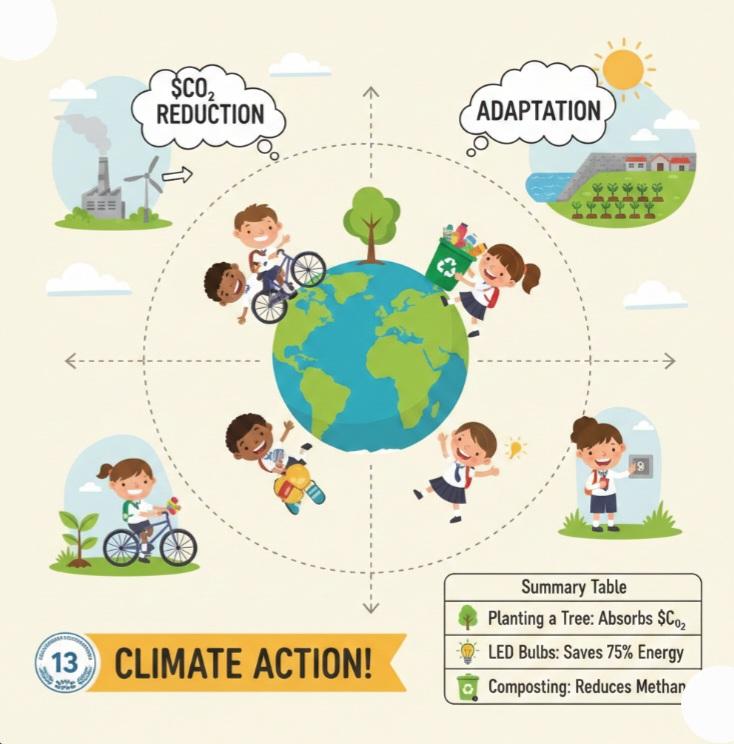
Climate change is one of the biggest challenges our world faces today, but it’s also an opportunity for us to rethink how we live, build, and grow. understanding the science behind it is the first step toward taking Climate Action.
1. What is Climate Action?
Climate Action refers to the efforts we take to stop global warming and protect our planet from the changes that are already happening. It is so important that the United Nations made it Goal 13 of the Sustainable Development Goals (SDGs).
It involves two main strategies:
Mitigation: Reducing the "Greenhouse Gases" (like CO_{2} and methane) that we put into the air.
Adaptation: Learning to live with the changes, such as building stronger sea walls or planting crops that can survive droughts.
2. The Science: Why is the Earth Warming?
The Earth has a natural "blanket" called the Greenhouse Effect. This is usually a good thing because it keeps our planet warm enough to live on.
However, human activities—like burning coal for electricity, driving petrol cars, and cutting down forests—have made this blanket too thick. This extra heat is causing:
Melting Glaciers: Leading to rising sea levels.
Extreme Weather: More frequent floods, droughts, and super-storms.
Habitat Loss: Polar bears and coral reefs are struggling to survive.
3. How You Can Take Action
You don't have to be a scientist or a politician to make a difference. Here are simple ways you can lead the way:
At Home
Be an "Energy Detective": Turn off lights and fans when you leave a room. Unplug chargers when they aren't in use.
The 3 R's: Reduce what you buy, Reuse what you have, and Recycle what’s left. Making new products uses a lot of energy!
Save Water: It takes a lot of electricity to pump and clean water. Shorter showers help the climate too.
At School
Go Green for Lunch: Try to have meat-free days (like "Meatless Mondays"). Producing vegetables uses much less water and land than producing meat.
Start a Club: Gather your friends to plant trees or start a small school garden. Trees are nature's best carbon-absorbers.
In Your Community
Walk or Cycle: For short distances, avoid using a car. It’s better for your health and the air.
Spread the Word: Talk to your parents and friends about why saving the planet matters. Your voice is powerful!