
Introduction
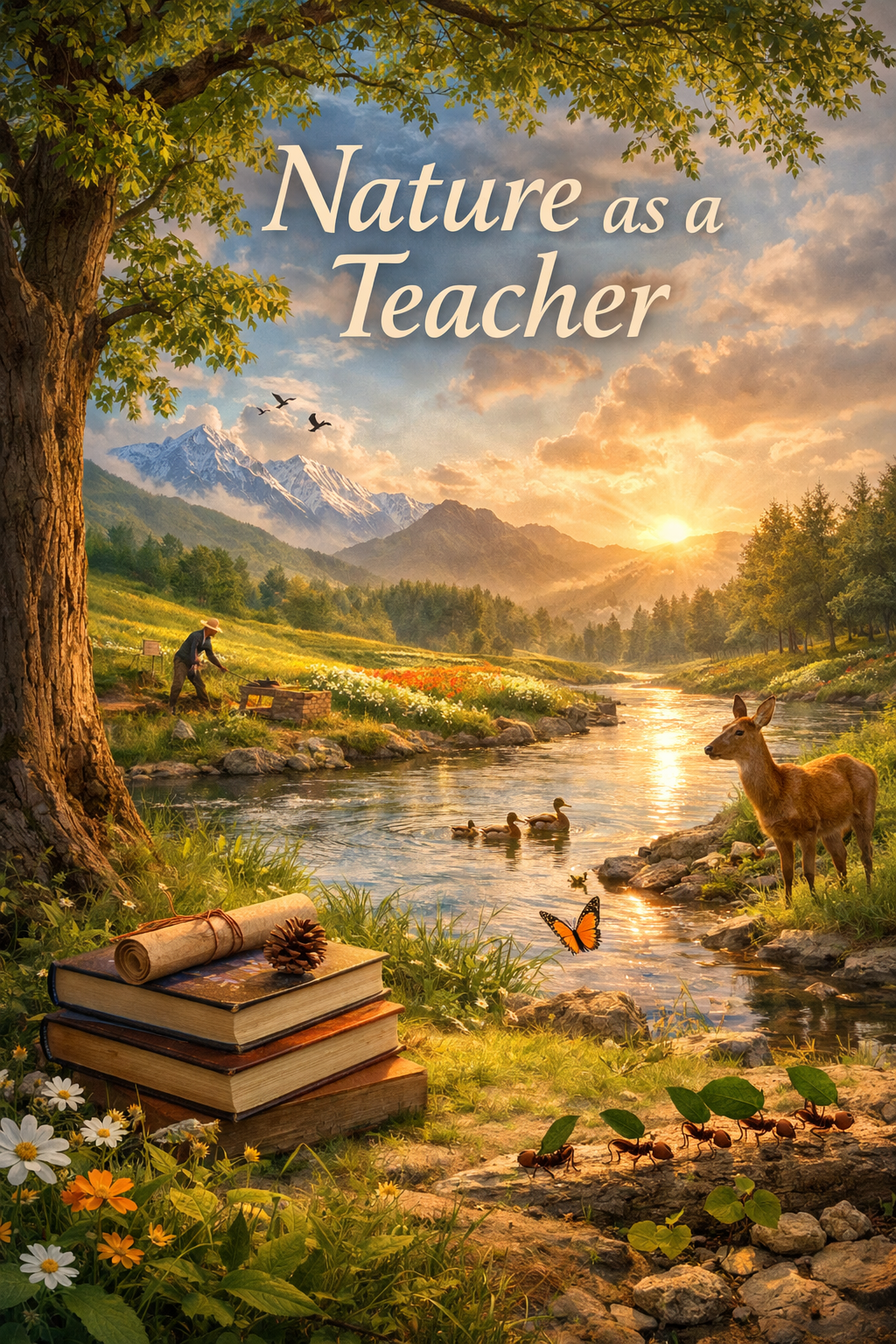
Since the beginning of human civilization, nature has played a very important role in shaping human life. Long before books, schools, and teachers existed, nature itself was the greatest teacher. Human beings learned how to live, survive, and grow by carefully observing nature. The rising of the sun taught us discipline, rivers taught us movement and patience, trees taught us generosity, and animals taught us cooperation and survival skills. Even today, when science and technology have advanced greatly, nature continues to teach us valuable lessons about life, behavior, and responsibility.
Nature includes everything around us—air, water, land, forests, mountains, rivers, animals, birds, and even the changing seasons. These elements are not just resources for human use; they are also silent teachers. They do not speak in words, yet their actions convey deep messages. Unfortunately, modern society often ignores these lessons and focuses only on exploiting nature for personal benefit. As a result, environmental problems like pollution, climate change, and loss of biodiversity have increased.
Part 2: Moral and Ethical Lessons from Nature
One of the greatest moral lessons nature teaches us is selflessness. Trees are the best example of this quality. A tree gives us fruits, shade, flowers, wood, and oxygen. It asks for nothing in return. Even when a tree is cut down, it continues to serve humans by providing wood for furniture, paper, and fuel.
Rivers also teach us selflessness. They flow continuously, providing water for drinking, farming, and industries. They nourish fields and support life wherever they go. They do not stop or change direction for personal benefit.
Part 3: Nature and Human Society
In ancient times, people respected nature as a powerful force. Rivers like the Indus, Nile, and Ganga gave rise to great civilizations. These rivers provided water for drinking, irrigation for farming, and routes for trade. People settled near rivers because they understood the value of natural resources.
Forests provided wood, fruits, herbs, and shelter. Mountains protected regions from invasions and helped regulate climate. Nature guided early humans on where to live and how to survive. They learned to read signs from nature, such as weather changes, animal behavior, and seasonal patterns.
This close relationship taught humans respect and gratitude toward nature. Many ancient cultures worshipped natural elements like the sun, moon, rivers, trees, and animals. This shows that people saw nature not just as a resource, but as a teacher and protector.
Conclusion
Nature is the greatest teacher of all. Without using words, it teaches humans the most important lessons of life. From nature, we learn discipline through the rising sun, patience from growing trees, hard work from ants and bees, and selflessness from rivers and trees. Nature shows us how to live in harmony, maintain balance, and respect limits. These lessons are essential not only for personal growth but also for building a peaceful and responsible society.
Human civilization has always depended on nature for survival and progress. However, in the race for development and comfort, humans have forgotten the wisdom that nature offers. Environmental problems such as pollution, climate change, deforestation, and loss of wildlife are clear signs that we have ignored nature’s teachings. Nature reminds us that progress without responsibility leads to destruction.