
---
🇮🇳 The Historic Day at Port Blair: When Netaji’s Flag Marked India’s Silent Freedom — 30 December 1943
India’s long struggle for independence is filled with countless sacrifices, revolutionary leaders, and unforgettable moments that reshaped the destiny of a nation. Among these, one moment stands out for its powerful symbolism and rare boldness — the hoisting of the Indian national flag by Netaji Subhas Chandra Bose in Port Blair on 30 December 1943. At a time when India was still under British rule, and freedom seemed distant, this single act of courage lit a spark of hope and strengthened the belief that independence was not only possible, but inevitable.
To fully understand the importance of this event, we must first look at the circumstances that led to this moment. Subhas Chandra Bose was not just a freedom fighter; he was a visionary leader who believed that India’s liberation required more than petitions and negotiations — it demanded direct action. After disagreements with the Congress leadership over the approach towards independence, Bose followed his own political path and became the leader of the Azad Hind Government and the Indian National Army (INA). Guided by his famous words, “Give me blood, and I will give you freedom,” he inspired thousands of Indians, both at home and abroad, to join the cause of independence.
Meanwhile, the world was in the midst of World War II, and the global political landscape was shifting rapidly. The Andaman and Nicobar Islands had fallen under Japanese control in 1942, after the British were forced to withdraw. Recognising Bose’s determination and leadership, the Japanese invited him to take over administrative control of the islands as part of the territory of the Provisional Government of Azad Hind, which Japan had officially recognised. For the first time, Netaji had an opportunity to demonstrate the existence of a government that claimed to represent a free India.
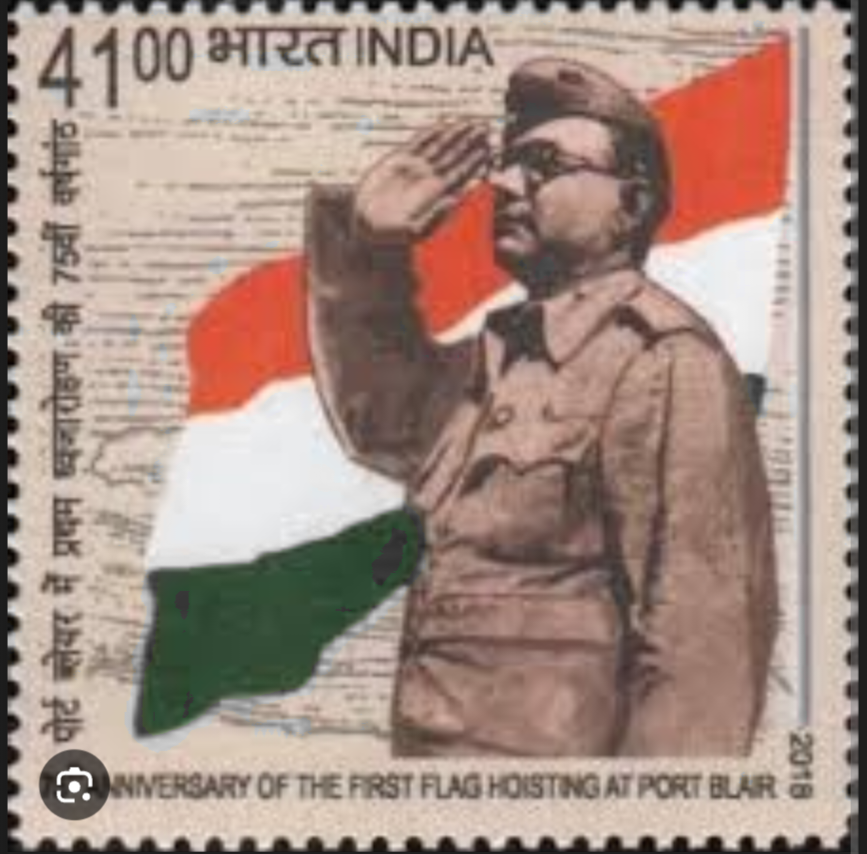
On 29 December 1943, Netaji reached Port Blair, greeted by enthusiastic crowds and INA soldiers. But it was the next day — 30 December — that would become legendary. Standing before the sea, against the backdrop of the blue horizon, Netaji raised the tricolour flag of India on Indian soil that was not under British authority. This historic act marked the first time during the colonial period that the national flag was hoisted in a territory declared liberated from British rule. The symbolism was powerful: the flag fluttering in the ocean breeze was not only a piece of cloth, but a declaration of India’s right to self-governance.
During this visit, Netaji also renamed the islands to express the true spirit of sacrifice and freedom. Andaman was named Shaheed Dweep — “Island of Martyrs” — honouring the countless freedom fighters who had suffered and died in the infamous Cellular Jail, often called Kala Pani. Nicobar was renamed Swaraj Dweep — “Island of Self-Rule” — representing the dream of independence that every Indian cherished. These new names captured the emotional connection between the islands and India’s struggle, reminding future generations of the cost of freedom.
What makes this moment even more remarkable is the clarity of Netaji’s vision. At a time when many believed that independence was still a distant dream, Bose acted as though freedom had already been achieved. His confidence gave strength to millions who were waiting for a leader who dared to challenge British authority openly. While his approach differed from that of other national leaders, his commitment to India’s liberation was unwavering. The flag at Port Blair became a symbol of resistance, courage, and unity, even though freedom was still four years away.
It is important to recognise that the hoisting of the flag in Port Blair was not simply a ceremonial event. It carried deep political significance. By raising the flag in a territory recognised as liberated, Bose sent a message to the world that India was ready to take its place among free nations. He proved that independence was not just an aspiration — it was a living reality that could be claimed with conviction and sacrifice. The event electrified the supporters of the freedom movement and reinforced the commitment of INA soldiers who were preparing to wage battle for India’s liberation.
Even after India gained independence in 1947, the legacy of 30 December 1943 remained alive. The names Shaheed Dweep and Swaraj Dweep were officially restored by the Government of India decades later, acknowledging Netaji’s historic role and ensuring that the significance of his actions remained part of public memory. Every year, admirers of Bose pay tribute to this day as a reminder of the fearless spirit that defined the freedom struggle.
The hoisting of the flag at Port Blair teaches us several valuable lessons. It shows that freedom requires courage, vision, and action. It reminds us that independence was not achieved overnight — it was the result of countless struggles fought across India, from Delhi to Kolkata, from Hyderabad to Port Blair. It also highlights the importance of unity, determination, and self-belief. Netaji did not wait for the ideal conditions; he created them through conviction and leadership. His actions inspire us to face challenges in our own lives with similar resolve.
Today, when we see the tricolour flying proudly across the nation — at schools, government buildings, stadiums, and international events — we must remember that its journey began long before 1947. One of its earliest and most meaningful flights took place on a quiet island in the Bay of Bengal, where a leader with an unshakeable dream of freedom raised it with pride and determination.
30 December 1943 is not just a date — it is a declaration.
A declaration that India’s freedom was not gifted; it was earned, claimed, and fought for.
And among those who carried that flame, Netaji Subhas Chandra Bose stands as a shining example of strength, leadership, and courage.
By,
PRESHTI JAIN ✨️
---