
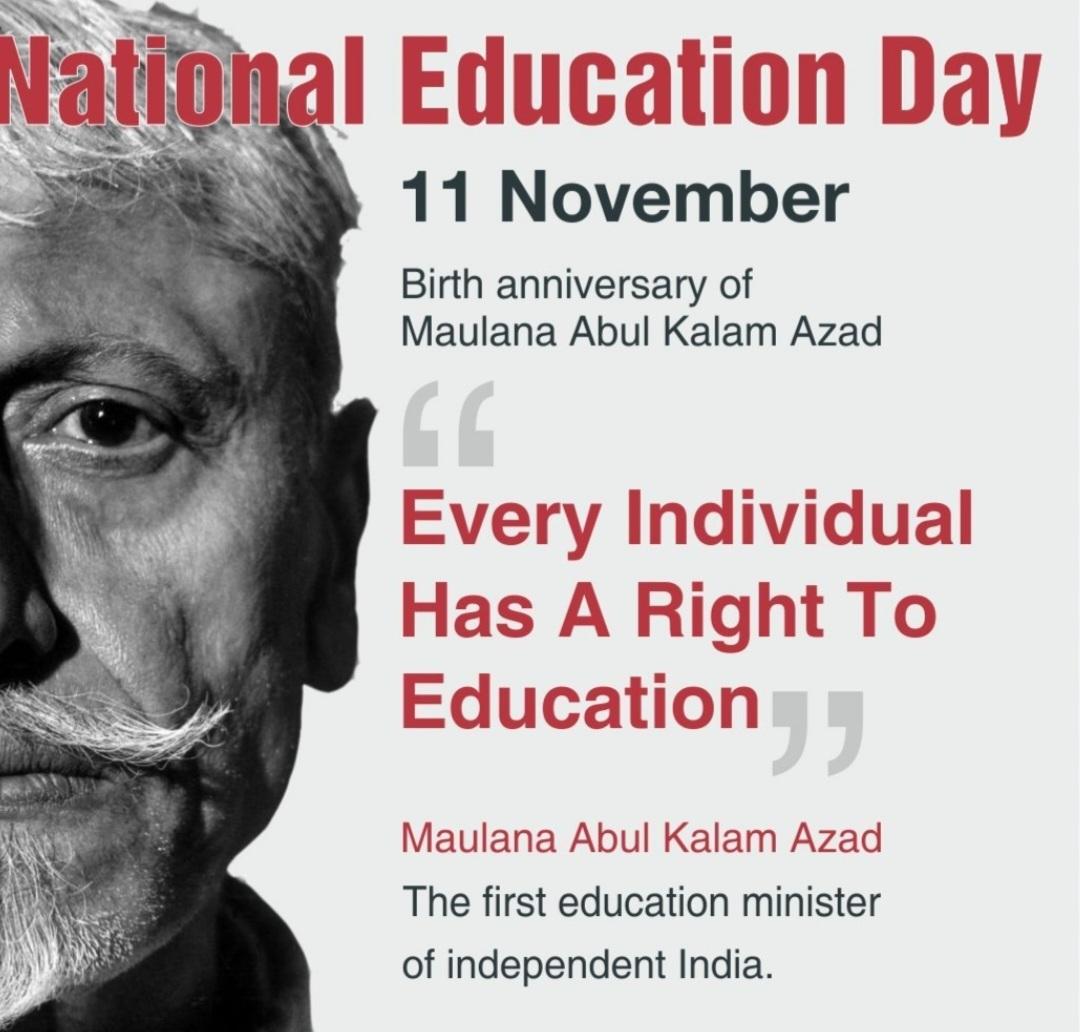
National Education Day is celebrated on November 11 every year in honor of Maulana Abul Kalam Azad, the first Education Minister of independent India and a prominent educationist. This day highlights the importance of education in shaping India's future. With 65% of the nation's population under the age of 35, it is crucial to provide them with opportunities for quality education and skills development. The Government of India is dedicated to building strong education infrastructure that fosters the holistic development of students and empowers the youth to drive the nation towards progress.
The Government of India has taken significant strides to promote access to education through various initiatives and constitutional provisions. The introduction of free primary education, reinforced by the 86th Amendment of the Constitution through Article 21-A, guarantees free and compulsory education for children aged six to fourteen as a Fundamental Right. The Rights to Education (RTE) Act, 2009, which came into effect on April 1, 2010, further supports this by ensuring that every child receives quality elementary education in a formal school that meets prescribed norms. These legal frameworks, backed by government schemes and initiatives, reflect India’s commitment to building an inclusive and equitable educational system for all.
NEP 2020: Under the dynamic leadership of Prime Minister Narendra Modi, the Union Cabinet of India approved the National Education Policy (NEP) 2020 on July 29, 2020. The NEP seeks to overhaul India's education system to better align with the needs of the 21st century, fostering a more inclusive and forward-thinking approach
PM SHRI: Prime Minister Shri Narendra Modi approved the PM SHRI Schools (PM Schools for Rising India) scheme on 7th September 2022. The initiative aims to strengthen over 14,500 schools across India, showcasing the components of the National Education Policy 2020. The scheme will foster quality education, cognitive development, and 21st-century skills in students. With a total project cost of ₹27,360 crore, it will be implemented over five years (2022-2027), with a central share of ₹18,128 crore.[4]
Samagra Shiksha: Aligned with the NEP 2020 recommendations, Samagra Shiksha aims to provide quality education with an inclusive and equitable classroom environment for all children, addressing their diverse backgrounds and needs. The scheme, launched on April 1, 2021, will continue for five years, ending on March 31, 2026. It focuses on fostering active participation and enhancing academic abilities across various student groups.
The Ministry of Education, Government of India, released the All India Survey on Higher Education (AISHE) 2021-2022 in January 2024. Since its inception in 2011, AISHE has been collecting comprehensive data from all registered Higher Educational Institutions (HEIs) across the country, covering key parameters such as student enrolment, faculty, and infrastructure. The survey highlights significant improvements over the years, reflecting the positive advancements in India’s education sector, with increased enrolment, enhanced inclusivity, and stronger infrastructure, contributing to a more robust and dynamic higher education system.
Female enrolment has also shown remarkable growth, rising from 1.57 crore in 2014-15 to 2.07 crore in 2021-22, an increase of 32%. The enrolment of students from disadvantaged groups, including SC, ST, OBC, and minorities, has grown significantly, with notable increases in female enrolment across all categories. In 2021-22, the Gender Parity Index (GPI) reached 1.01, reflecting a consistent trend of more female students enroling in higher education than males
Education holds the power to break barriers, open doors of opportunity, and empower individuals to contribute meaningfully to society. India’s educational landscape has evolved significantly, building a robust system through continuous innovation and comprehensive reforms. By embracing a holistic, 360-degree approach that integrates new ideas, technologies, and teaching methods, India is creating an environment where youth can thrive, transforming them into key assets for the nation’s growth. As we honor the legacy of Maulana Abul Kalam Azad, let us reaffirm our commitment to education as the cornerstone of a brighter, more inclusive future for all.