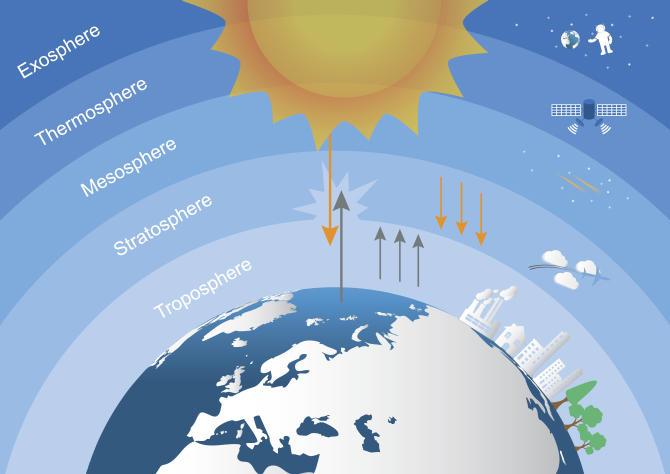
Earth’s atmosphere comprises multiple layers, each with its own role. Above the troposphere, Earth’s innermost layer (which contains Earth’s oxygen and houses what we call weather), is the stratosphere. This is a comparatively dry atmospheric layer associated with weather balloons, high-altitude planes, and polar stratospheric clouds—as well as the ozone layer. The ozone layer sits toward the bottom of the stratosphere, roughly 20 to 40 kilometers (66,000 and 131,000 feet) above the ground. It gets its name from its high concentration of ozone, a molecule born from UV light’s contact with the stratosphere. When UV rays strike oxygen molecules (O2) in this layer, those molecules break apart, resulting in two highly reactive individual oxygen atoms known as atomic oxygen. Atomic oxygen joins regular oxygen molecules to create ozone (O3). This cycle, called the ozone-oxygen cycle, creates an ozone concentration of roughly 2 to 8 parts per million to form the ozone layer.