
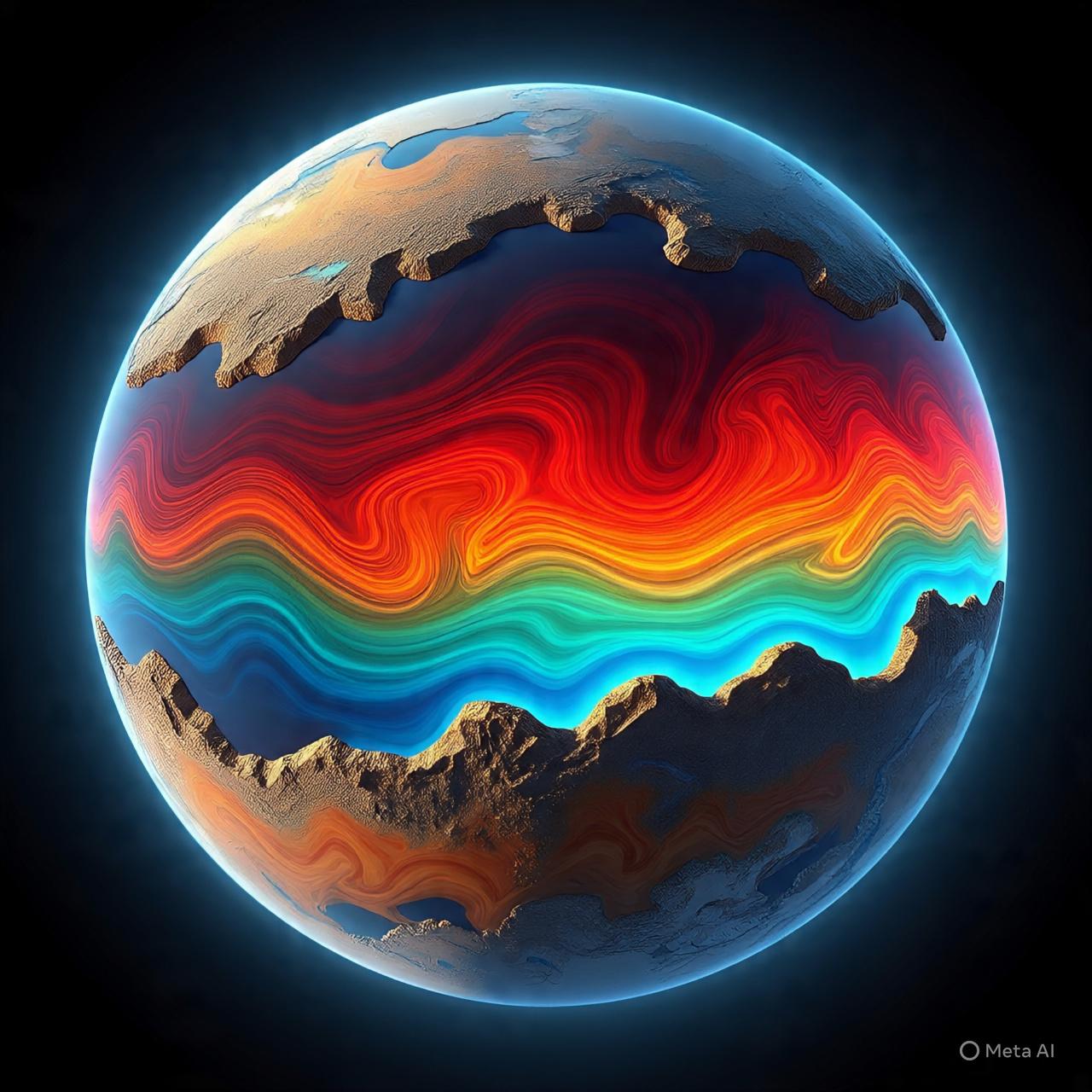
*The Layers of the Earth 🌎*
The Earth is composed of several distinct layers, each with its own unique characteristics and functions. Understanding these layers is essential for grasping the Earth's structure, processes, and evolution.
*1. Crust 🌊*
The outermost layer of the Earth is the crust, ranging in thickness from 5-70 km. The crust is composed of rocks and minerals and is broken into several large tectonic plates that move relative to each other. These plates interact at their boundaries, resulting in geological phenomena such as earthquakes, volcanic eruptions, and mountain formation. The crust is divided into two main types: continental crust, which is thicker and less dense, and oceanic crust, which is thinner and denser.
*2. Mantle 🔥*
Beneath the crust lies the mantle, a thick layer of hot, viscous rock that extends from about 35 km to 2,900 km in depth. The mantle is composed of silicate minerals rich in iron and magnesium. It is divided into the upper mantle and the lower mantle. Convection currents in the mantle drive the movement of tectonic plates, influencing geological processes on the Earth's surface.
*3. Outer Core 💧*
The outer core is a liquid layer composed primarily of iron and nickel, located between 2,900 km and 5,150 km below the Earth's surface. This layer generates the Earth's magnetic field through the movement of electrically conductive iron. The magnetic field plays a crucial role in protecting the Earth from solar winds and cosmic radiation.
*4. Inner Core 🔩*
At the center of the Earth lies the inner core, a solid ball of iron and nickel with a radius of about 1,220 km. Despite extremely high temperatures, the inner core remains solid due to immense pressure. The inner core is believed to influence the Earth's magnetic field and plays a role in the planet's overall dynamics.
*Importance of Understanding Earth's Layers*
Studying the layers of the Earth helps scientists understand geological processes such as earthquakes, volcanic activity, and plate tectonics. This knowledge is essential for predicting natural disasters, exploring natural resources, and gaining insights into the Earth's formation and evolution.
*Technological Advances in Earth Science*
Advances in technology, such as seismic imaging and drilling, have allowed scientists to study the Earth's layers in greater detail. These technologies provide valuable data on the composition, structure, and behavior of the Earth's interior, contributing to a deeper understanding of our planet.
In conclusion, the layers of the Earth are complex and dynamic, each playing a vital role in the planet's structure and processes. Continued research and exploration of these layers will enhance our understanding of the Earth and its natural phenomena.