
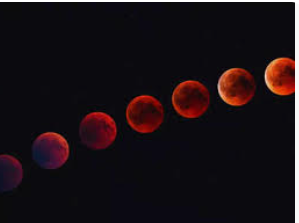
🌑 Lunar Eclipse
A lunar eclipse is a beautiful natural event that happens when the Earth comes between the Sun and the Moon. During this time, the Earth blocks sunlight from directly reaching the Moon, and instead, the Moon is covered by the Earth’s shadow. This makes the Moon appear dark, reddish, or copper-colored.
Types of Lunar Eclipse
-
Total Lunar Eclipse – The entire Moon passes through Earth’s shadow and looks red (called a "Blood Moon").
-
Partial Lunar Eclipse – Only a part of the Moon enters Earth’s shadow, so it looks partly dark.
-
Penumbral Lunar Eclipse – The Moon passes through the faint outer shadow of Earth, making only a slight change in brightness.
Why Does the Moon Look Red?
During a total lunar eclipse, some sunlight still reaches the Moon, but it passes through the Earth’s atmosphere first. The atmosphere scatters blue light and allows red and orange light to reach the Moon. That is why the Moon looks red.
How Often Do They Happen?
Lunar eclipses do not happen every month because the Moon’s orbit is tilted. They occur only a few times a year, and can be seen from many places on Earth, unlike solar eclipses which are visible only in small areas.
Importance of Lunar Eclipses
-
In ancient times, people thought eclipses were signs from the gods.
-
Today, scientists use eclipses to study Earth’s atmosphere and the Moon’s surface.
-
They are also special events for sky-watchers, since they can be seen safely with the naked eye.
Conclusion
A lunar eclipse is not only a scientific phenomenon but also a breathtaking sight. It reminds us of the harmony of the Sun, Earth, and Moon in space. Watching a lunar eclipse is like seeing nature’s own show in the night sky.